In order for the children to conceive the length and proportion we play various games:
Handling of objects is the key to knowledge, as Piaget says. Observation and comparisons come afterwards.
I would like to share some of my projects with you, just because they helped children to understand and enjoy mathematics.
fractios
In order for the children to understand fractions (I mean the half , the quarter), we apply certain routines: First we have at hand the recipe for play dough, every time we want to make some, we find the ingredients and we measure the quantities(which means they are familiar with the concept of 1/2, etc.
Children enjoy it and they learn about quantities, at the same time.
Origami,I found helps a lot too in understanding fractions .
We organize some handicrafts that involve folding shapes. We make birds, butterflies, babies in prams and various other applications that help them to get a sense of the ½ and ¼ portions.
e.g. ¼ of a circle is the beak of a bird. ½ is its body and in another size the foliage.

height
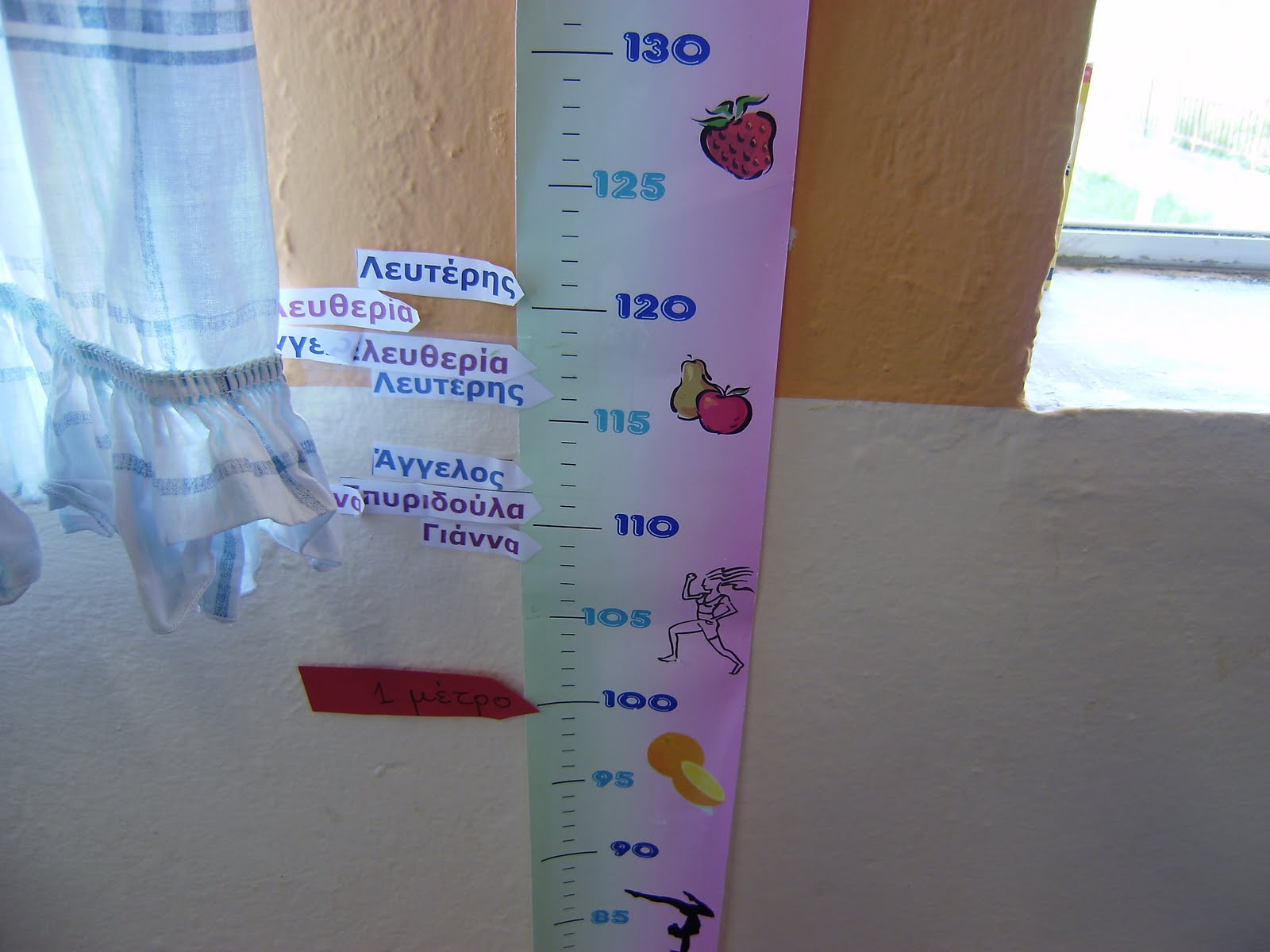
We measure ourselves against the wall. We have created a measure with centimeters and we put our names in the centimeters we reach.
First we measure ourselves barefooted, and we see our height.
After some months we measure ourselves and put the new results. The difference we take home in a piece of colored tape.
This activity triggers a lot of comparisons and observations.

length
First I cut small pieces (of one, two and three centimeters, different colors).
The children are asked to put as many pieces of tapes as they think are appropriate to reach the line, at ten centimeters(the first piece that I set.
At the end they mention how many pieces of tape they put together in order to reach the line (at ten centimeters). We discuss why is different for everyone, and find reasons and observe situations.

pizza
We discuss about the pizzas and what sort of pizzas we like.
I propose to make the pizza we like, with the ingredients we like. Sometimes I have a list of the ingredients with names and photos, and they make their own pizza, in paper (writting the ingredients underneath, if they like).

At the end we decide to share the pizza with three or one of our friends.We have to share it in equal pieces, and usually we succeed.

this project is a verification of the concept of fragments
At the end we decide to share the pizza with three or one of our friends.
We have to share it in equal pieces, and usually we succeed.



 At the end we decide to share the pizza with three or one of our friends.We have to share it in equal pieces, and usually we succeed.
 this project is a verification of the concept of fragments

 They are only three(3), as the diagram above shows. The first one has two at its back , the middle one has one at its front and one at its back and the last one has two at its front.


